
Eco-Friendly Clean Agent Fire Extinguishers | LIFEGUARD®
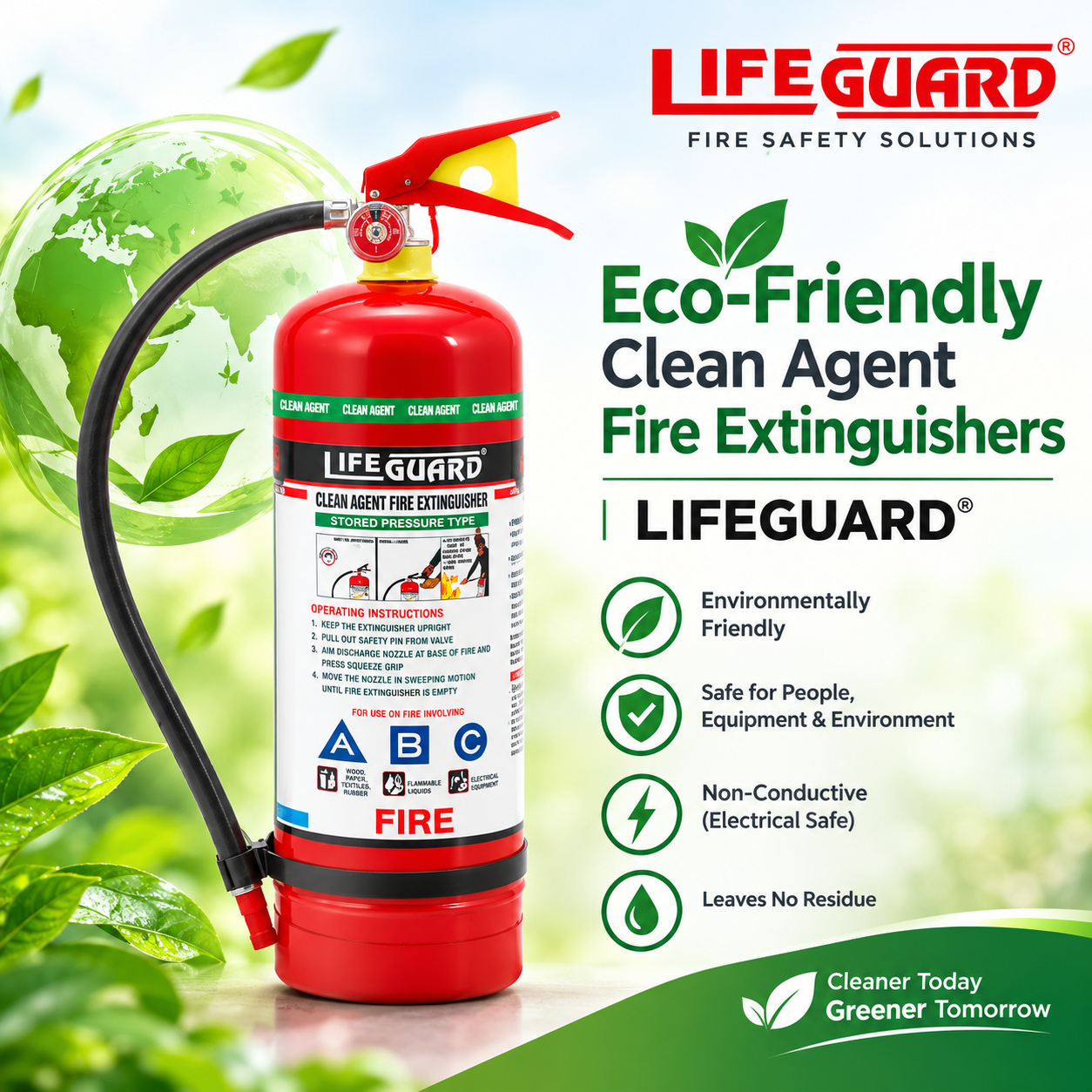
ECO-FRIENDLY CLEAN AGENT GAS TYPE FIRE EXTINGUISHERS – LIFEGUARD®
Advanced Clean Agent Fire Protection Solutions for Modern Facilities
LIFEGUARD® Eco-Friendly Clean Agent Gas Type Fire Extinguishers and Fire Suppression Solutions are designed for applications where effective fire protection and the preservation of sensitive equipment are important considerations. United Fire Equipments Pvt. Ltd. (UFEPL), the company behind the LIFEGUARD® fire safety brand, offers fire protection solutions for commercial buildings, industrial facilities, data centres, electrical installations, control rooms, communication infrastructure, and other applications requiring carefully selected firefighting technology.
Clean agent fire suppression technology uses gaseous or vaporizing extinguishing agents to control fires while minimizing the residue associated with conventional dry chemical powder extinguishers. Depending on the agent and the system design, clean agents can be suitable for protecting sensitive electronic equipment, computer systems, electrical panels, and valuable assets where post-fire cleanup and equipment downtime are major concerns.
The LIFEGUARD® approach emphasizes application-specific fire protection, appropriate equipment selection, and compliance with relevant product standards and system requirements. Environmental performance, fire ratings, and suitability must always be verified against the specific agent, equipment model, and supporting technical documentation.
What Is an Eco-Friendly Clean Agent Fire Extinguisher?
An eco-friendly clean agent fire extinguisher is a fire suppression device that uses an approved extinguishing agent designed to control specified fire hazards while leaving little or no solid residue after discharge.
Unlike dry chemical powder extinguishers, clean agent systems are generally selected for applications where minimizing contamination of protected equipment is a priority. Depending on the agent, fire conditions, and application, suppression may occur through heat absorption, chemical interaction with the combustion process, or a combination of mechanisms.
The term “eco-friendly” is not a universal technical classification. The environmental impact of a clean agent depends on its chemical composition, atmospheric lifetime, global warming potential (GWP), ozone depletion potential (ODP), manufacturing and handling considerations, and applicable environmental regulations. Buyers should therefore assess the specific agent rather than relying on the marketing term alone.
Key Benefits of LIFEGUARD® Clean Agent Fire Protection
1. Clean Fire Suppression
Clean agents are designed to minimize solid residue from the extinguishing medium, helping reduce contamination and cleanup requirements in suitable applications.
2. Protection for Sensitive Equipment
Appropriately selected clean agent solutions may be used to protect data processing equipment, electrical control systems, communication infrastructure, and other valuable assets.
3. Reduced Equipment Downtime
By minimizing residue from the extinguishing agent, suitable clean agent systems can help reduce post-discharge cleaning requirements. Actual recovery time depends on the fire damage, agent, system operation, and facility conditions.
4. Application-Specific Fire Protection
Clean agent solutions are available in different formulations and configurations for portable firefighting and engineered fixed fire suppression systems.
5. Environmental Considerations
Certain clean agents offer favorable environmental characteristics compared with some legacy halocarbon agents. However, environmental performance differs significantly among agents. Select products based on verified environmental data and applicable regulations.
6. Integration with Fire Safety Systems
Engineered clean agent systems may be integrated with compatible fire detection, alarm, control, and release arrangements where required by the design and applicable standards.
7. Support for Critical Infrastructure
Clean agent technology is commonly considered for critical environments where fire incidents can cause significant operational disruption, data loss, or damage to high-value equipment.
How Does Clean Agent Gas Fire Suppression Work?
Clean agent fire suppression works by using an extinguishing medium suited to the fire hazard and protected environment. Different agents work through different mechanisms.
Some gaseous agents absorb heat from the fire, while others interrupt combustion chemistry. Certain agents are stored as liquids and discharged so that they vaporize during operation. The specific extinguishing mechanism, concentration, discharge design, and performance depend on the agent and system configuration.
In engineered total-flooding systems, the required concentration must be achieved and maintained in the protected enclosure for the specified design period. Enclosure integrity, ventilation, pressure relief, discharge arrangement, and post-discharge procedures are important parts of the system design.
Clean agent systems should be designed, installed, inspected, and maintained by qualified professionals in accordance with the applicable standards, manufacturer instructions, and local fire safety regulations.
Applications of Eco-Friendly Clean Agent Fire Suppression
Data Centres and Server Rooms
Data centres contain servers, network equipment, storage systems, and power infrastructure that may be vulnerable to fire, smoke, and contamination. Properly engineered clean agent systems can provide fire suppression for suitable protected enclosures.
IT Infrastructure and Network Operations Centres
Network operations centres, telecom rooms, and IT equipment rooms can benefit from fire protection solutions designed to limit agent residue and operational disruption.
Electrical and Control Rooms
Power control rooms, switchgear rooms, automation panels, and instrumentation areas may require specialized fire protection. The appropriate agent and system must be selected according to the electrical hazard and the equipment manufacturer's recommendations.
Telecommunications Facilities
Telecom exchanges, switching rooms, communication equipment spaces, and related infrastructure may use engineered clean agent systems to protect critical equipment.
Banking and Financial Infrastructure
Banking technology rooms, transaction processing facilities, and other critical IT environments can consider clean agent protection as part of a comprehensive fire risk management strategy.
Industrial Automation and Process Control
Manufacturing facilities, process control rooms, and industrial automation installations may require fire suppression that limits contamination of sensitive control and monitoring equipment.
Archives, Museums and Sensitive Assets
Certain clean agent solutions may be appropriate for selected heritage collections, archives, and valuable assets, subject to the particular material sensitivities and applicable conservation requirements.
Clean Agent Fire Extinguishers vs. Conventional Extinguishers
Different extinguishing technologies serve different hazards. Selection should be based on the fire risk, equipment involved, occupancy, and applicable standards.
Clean agent extinguishers: Designed for specified fire hazards where minimizing extinguishing-agent residue is important.
ABC dry chemical powder extinguishers: Used for compatible combustible solid, flammable liquid, and flammable gas hazards under the applicable fire classification and product rating.
CO₂ fire extinguishers: Commonly selected for suitable electrical equipment and certain flammable-liquid risks, with precautions for enclosed spaces and personnel exposure.
Water-based extinguishers: Used for compatible ordinary combustible materials, depending on the model and certified rating.
Foam extinguishers: Suitable for specified ordinary combustible and flammable-liquid hazards.
Wet chemical extinguishers: Designed for compatible cooking-oil and fat fire hazards.
No single extinguisher type is suitable for every application. Clean agents should not automatically be assumed suitable for all combustible metals, reactive chemicals, cooking oils, or lithium-ion battery fires.
Understanding Common Clean Agent Types
Clean agent products differ in their environmental profile, storage requirements, extinguishing characteristics, and application suitability.
FK-5-1-12 Clean Agent
FK-5-1-12 is a fluorinated clean extinguishing agent used in certain engineered fire suppression systems. It has zero ozone depletion potential and a very low global warming potential compared with many legacy fluorinated suppression agents. Its environmental profile and regulatory status should be checked against current, jurisdiction-specific requirements.
HFC-Based Clean Agents
Certain hydrofluorocarbon (HFC) agents have been used in clean agent fire suppression systems because they can suppress fires without leaving solid residue. Their global warming potential and regulatory treatment vary by agent and jurisdiction, so environmental suitability must be assessed carefully.
Other Clean Agent Technologies
Other gaseous or vaporizing suppression technologies may be available depending on the hazard, equipment configuration, and local approvals. They should not be treated as environmentally equivalent without verified technical data.
The correct selection depends on fire risk, protected enclosure, personnel safety, environmental regulations, and system performance requirements.
Why Choose LIFEGUARD® from United Fire Equipments Pvt. Ltd.?
United Fire Equipments Pvt. Ltd. is associated with the LIFEGUARD® fire safety equipment brand and has been manufacturing firefighting equipment since 1991. The company serves customers across industrial, commercial, institutional, and infrastructure sectors.
For projects involving sensitive equipment or critical facilities, choosing the correct fire suppression technology requires an understanding of the hazard, the protected enclosure, equipment sensitivity, personnel occupancy, and applicable codes. LIFEGUARD® can be approached for product information and assistance in evaluating suitable fire protection options.
UFEPL is also an authorized distributor for Kidde gas suppression solutions. Customers considering engineered gas suppression systems can enquire about the applicable product range, technical documentation, and project-specific requirements.
All product availability, environmental claims, certifications, and system approvals should be confirmed for the specific product and project before specification or purchase.
Important Safety and System Design Considerations
Clean agent suppression systems require appropriate engineering and safety controls. Key considerations include:
Identification of the fire hazards and protected equipment.
Selection of an agent supported by appropriate technical data and approvals.
Calculation of the required design concentration and agent quantity.
Assessment of enclosure integrity, leakage, ventilation, and pressure relief.
Integration with compatible detection, alarm, shutdown, and release controls.
Evaluation of personnel exposure limits and safe evacuation requirements.
Provision of warning signs, alarms, operating instructions, and emergency procedures.
Periodic inspection, servicing, and maintenance in accordance with applicable standards.
For occupied spaces, clean agent concentration and exposure duration must be assessed against the agent's safety requirements. No clean agent should be described as universally harmless to people.
Lithium-ion battery fires require particular attention because thermal runaway can continue or recur after initial suppression. A standard clean agent system should not be assumed to provide the cooling needed to prevent battery reignition unless the complete solution has been specifically tested and approved for that hazard.
Frequently Asked Questions
What is a clean agent fire extinguisher?
A clean agent fire extinguisher uses an approved gaseous or vaporizing extinguishing medium designed to suppress specified fires while leaving minimal solid residue from the agent.
Are clean agent fire extinguishers environmentally friendly?
Environmental performance depends on the particular agent. Relevant factors include global warming potential, ozone depletion potential, atmospheric lifetime, and current environmental regulations. Verify the agent's technical and environmental documentation before making an environmental claim.
Are clean agent extinguishers suitable for server rooms?
Appropriately rated clean agent extinguishers may be considered for certain server room risks. For critical data centres, an engineered fixed suppression system may be more appropriate depending on the hazard assessment and project requirements.
Do clean agents leave residue?
Clean agents are generally selected for their low-residue or residue-free discharge characteristics. However, fire by-products, decomposition products, and contamination from the fire itself may still require cleanup.
What is FK-5-1-12?
FK-5-1-12 is a clean extinguishing agent used in certain engineered fire suppression systems. Its suitability depends on the design, applicable standards, environmental regulations, and the protected hazard.
Can clean agent systems protect lithium-ion batteries?
Not necessarily. Battery fires may involve thermal runaway, reignition, and substantial cooling requirements. The suppression solution must be specifically evaluated for the battery chemistry, installation, and fire scenario.
How can I enquire about LIFEGUARD® clean agent solutions?
Contact United Fire Equipments Pvt. Ltd. for information on suitable fire extinguishers, engineered gas suppression systems, and technical documentation relevant to your application.
Contact LIFEGUARD® – United Fire Equipments Pvt. Ltd.
United Fire Equipments Pvt. Ltd. (UFEPL)
LIFEGUARD® – Manufacturer of ISI-Certified Fire Safety Equipment
Phone: 8048034226
Email: ufe126@gmail.com
Email: info@lifeguardindia.in
Website: www.lifeguardindia.in
For clean agent fire protection enquiries, data centre fire suppression requirements, electrical equipment protection, or engineered gas suppression projects, contact our team to discuss your application and technical requirements.
LIFEGUARD® – Clean Agent Fire Protection for Critical Assets
Effective fire protection begins with selecting the right technology for the hazard. LIFEGUARD® and United Fire Equipments Pvt. Ltd. support informed fire safety decisions through product information, application-oriented guidance, and fire protection solutions tailored to the requirements of modern facilities.