
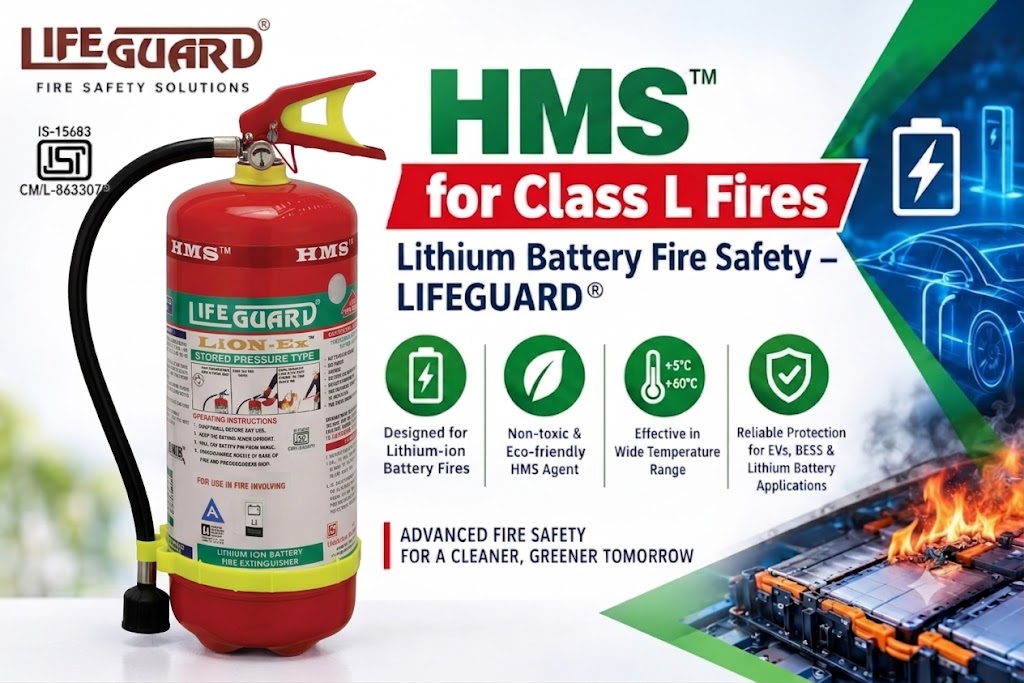
HMS for Class L Fires | Lithium Battery Fire Safety – LIFEGUARD®
Hydrated Mica Suspension (HMS): A New Approach to Lithium-Ion Battery Fire Protection
As electric mobility, renewable energy storage and battery-powered technologies continue to expand, lithium-ion battery fire safety has become a critical priority for industries worldwide. Battery fires can present complex challenges due to intense heat generation, thermal runaway, the potential for fire propagation between cells and the risk of reignition.
LIFEGUARD® India, the fire safety brand of United Fire Equipments Pvt. Ltd., is advancing specialised fire protection through Hydrated Mica Suspension (HMS), a mineral-based aqueous suspension developed for lithium-ion battery fire applications associated with Class L fire hazards.
HMS is designed to support effective cooling and fire suppression while helping address the risks associated with thermal runaway and reignition. It offers an application-focused approach to battery fire safety for electric vehicles, battery modules, battery energy storage systems and other lithium-ion battery installations, subject to the relevant product specifications and validated performance.
What Is HMS (Hydrated Mica Suspension)?
Hydrated Mica Suspension is a specially formulated, mineral-based aqueous extinguishing medium developed for lithium-ion battery fire applications.
Unlike conventional fire extinguishing agents designed primarily for ordinary combustible materials or flammable liquids, HMS is intended to address the specific challenges associated with lithium-ion battery incidents, where heat may persist within battery cells and reignition may occur even after visible flames have been suppressed.
Through its cooling and fire suppression characteristics, HMS is designed to help manage heat, suppress combustion and reduce the risk of fire propagation. Its suitability and performance should be assessed against the battery chemistry, cell configuration, incident conditions and relevant test results.
Why Is Specialised Protection Required for Class L Fires?
Lithium-ion battery fires can behave differently from conventional fires. When a battery cell enters thermal runaway, an uncontrolled chain of exothermic reactions may generate substantial heat and release flammable gases. Heat can spread to neighbouring cells, potentially resulting in further thermal runaway events.
Key challenges include:
Thermal runaway: Rapid, self-heating reactions within a battery cell.
Heat propagation: Transfer of heat from an affected cell to adjacent cells or modules.
Reignition risk: The possibility of renewed combustion after visible flames have been suppressed.
Complex fire suppression: The need to address both visible flames and residual heat within the battery assembly.
Application-specific hazards: Differences in battery chemistry, energy capacity, enclosure design and ventilation.
HMS is developed to support cooling and suppression strategies for these specialised fire scenarios. No extinguishing medium should be assumed to eliminate thermal runaway or reignition in every battery configuration without appropriate supporting tests.
How HMS Supports Lithium-Ion Battery Fire Suppression
1. Cooling-focused fire suppression
The aqueous formulation of HMS is designed to assist in absorbing heat from the affected fire area and supporting temperature reduction.
2. Support for thermal runaway mitigation
By helping manage heat around the affected battery assembly, HMS is intended to support efforts to limit thermal propagation. Results depend on the battery design, incident severity, application method and available cooling capacity.
3. Reignition risk management
Residual heat can remain a concern after flames are extinguished. HMS is developed with cooling and suppression objectives that support efforts to reduce the risk of renewed combustion. Continued monitoring and appropriate emergency procedures remain essential.
4. Mineral-based formulation
HMS incorporates hydrated mica in an aqueous suspension. Its handling, storage, material compatibility and environmental characteristics should be evaluated against the applicable technical documentation.
5. Application-oriented solutions
LIFEGUARD® develops HMS-based fire safety solutions for relevant lithium-ion battery hazards, with product selection guided by the intended application and supporting technical evidence.
Applications of HMS for Class L Fire Hazards
HMS-based solutions can be considered for specialised battery fire protection applications, including:
Electric two-wheelers and three-wheelers
Electric cars and commercial electric vehicles
Electric buses and fleet charging facilities
Lithium-ion battery packs, modules and testing facilities
Battery manufacturing and assembly plants
Battery energy storage systems (BESS)
Renewable energy storage installations
Battery research, development and testing laboratories
Battery service, repair and recycling facilities
Industrial sites handling lithium-ion battery systems
The appropriate HMS delivery system, application method and product configuration must be determined for the specific hazard. Large battery installations may require engineered detection, suppression, cooling, isolation and emergency response measures in addition to portable firefighting equipment.
LIFEGUARD® Lion-Ex® – HMS-Based Lithium-Ion Battery Fire Safety
LIFEGUARD®'s Lion-Ex® product range incorporates Hydrated Mica Suspension technology for specialised lithium-ion battery fire applications.
Available product configurations include compact portable formats and larger-capacity solutions, subject to the applicable product specifications.
Lion-Ex™ is intended to support battery fire response across relevant applications, including electric mobility and specialised industrial environments. Selection should be based on the required capacity, fire risk, operating conditions and validated product performance.
For technical evaluation, consult the relevant Technical Data Sheet (TDS), Safety Data Sheet (SDS), product instructions and applicable test reports.
Why Choose LIFEGUARD® HMS Technology?
United Fire Equipments Pvt. Ltd. combines firefighting equipment manufacturing experience with continued development of specialised fire safety solutions.
Specialised application: Developed for lithium-ion battery fire hazards.
Cooling-focused approach: Supports heat management during fire suppression.
Mineral-based technology: Formulated using hydrated mica in an aqueous suspension.
Multiple application possibilities: Relevant to electric mobility, battery facilities and energy storage environments.
Technical evaluation: Product selection supported by relevant specifications and available test documentation.
Integrated fire safety perspective: Can be evaluated as part of a broader battery fire prevention, detection, suppression and emergency response strategy.
Performance, electrical safety, environmental suitability and certification status should be confirmed using documentation applicable to the specific product and intended use.
Advancing Battery Fire Safety Through Innovation
The future of fire safety requires solutions that address emerging hazards alongside conventional fire protection. As lithium-ion batteries become increasingly important to transportation, industrial operations and energy storage, selecting suitable battery fire suppression technology is essential.
HMS by LIFEGUARD® represents an application-focused approach to lithium-ion battery fire suppression, with an emphasis on cooling, fire control and managing the risk of reignition.
Contact United Fire Equipments Pvt. Ltd. to discuss HMS-based fire safety solutions, technical documentation, product configurations and application-specific evaluation for your battery fire protection requirements.
LIFEGUARD® India – Innovative Fire Safety for an Electrified Future.